Tapas in Madrid: how to eat like a local without falling into the tourist trap
Where to go for tapas in Madrid by time of day and neighborhood, what to order at each spot, and which areas to avoid. With real opening hours and prices.
In Madrid, there are two ways to do tapas: the one you read about in guidebooks, and the one the locals actually do. The first costs three times as much and happens around the Plaza Mayor. The second starts at two in the afternoon at a bar counter in Lavapiés, and you won't find it in any ranking.
This article is about the second kind. It's not a list of the ten best bars — those lists change every year and are almost always written by someone who spent three days here. It's about how the tapas culture actually works in Madrid: what time, which neighborhood, what to order where, and which areas to steer clear of.
4–6 barsAN IDEAL ROUTE
19:30THE BEST TIME
La LatinaTHE TAPAS NEIGHBORHOOD
3–5 €BEER WITH A TAPA
1. Madrid is not Granada: here you pay for your tapa
Let's start with what disappoints most visitors who arrive with the wrong expectations.
Tapas in Madrid are not free. In Granada, you get a tapa with every drink; in León too; in Almería, in many places. In Madrid, no. There are exceptions — the odd bar in Lavapiés or Malasaña still keeps the tradition alive — but that's exactly what they are: exceptions.
What you do find is something else entirely, and arguably better: Madrid is the city with the greatest variety of tapas in Spain. It doesn't have one strong culinary identity of its own, like Seville or San Sebastián — it has all of them. Here, the old Castilian tavern serving callos and vermut sits alongside the Basque pintxos bar, the Asturian cider house, the Galician pulpo spot, and the modern bar turning out creative croquetas. It's the result of a century of people arriving from every corner of the country and opening their own bar.
The practical upshot: don't look for "the Madrid tapa." Look for the bar that does its own thing well.
2. Timing matters more than location
This is what separates the people who eat well from those who don't.
Time slot
What's happening
Where
13:00–14:00
Vermut. Quiet counters, neighborhood regulars
Classic taverns
14:00–16:00
Lunch. Set menus, packed bars
Neighborhood bars
16:00–19:30
Most kitchens are closed
—
19:30–21:00
The sweet spot. Lively counters, still room to breathe
Everywhere
21:00–23:00
Dinner. Absolutely packed
Everywhere
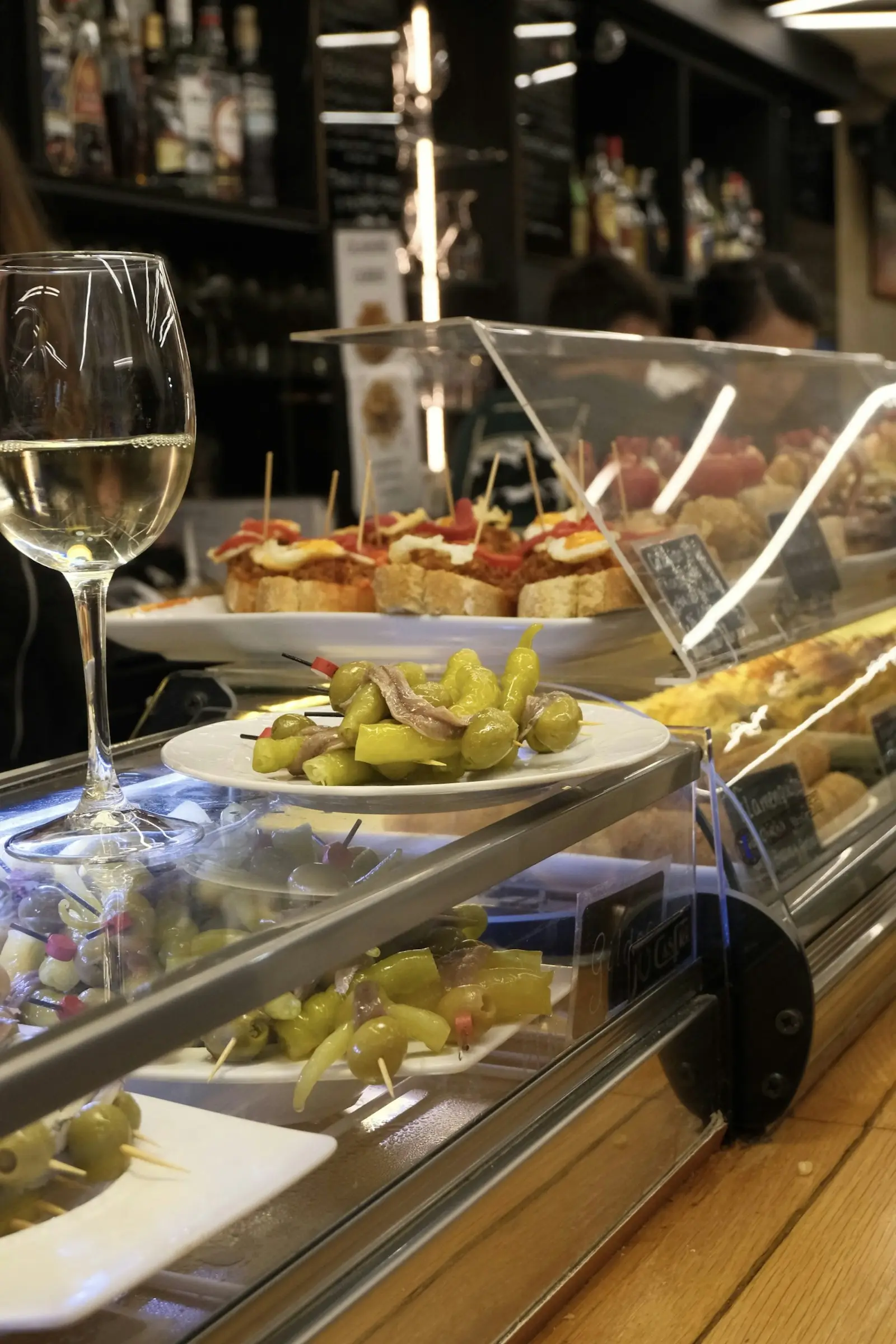
The midday vermut is a Madrid institution, especially on Saturdays and Sundays. Draught vermut, some conservas, a plate of anchovies, standing at the bar. It's not a pre-lunch aperitif — for many people, it is lunch.
Between 16:00 and 19:30, most kitchens shut. If you turn up at an off hour, head to tapas bars that keep the counter open. It's the classic visitor mistake: showing up at five in the afternoon looking for food and finding everything closed.
Draught vermut, conservas, and anchovies: the midday ritual of Madrid — Raúl Mermans García / Unsplash
"In Madrid, there are two ways to do tapas: the one you read about in guidebooks, and the one the locals actually do."
Tapas in Madrid · Fee4Me
3. Neighborhood by neighborhood: what to expect from each
La Latina. The classic route, and for good reason: the Cava Baja packs more bar counters per meter than any other street in Spain. A typical crawl takes in four to six bars over two or three hours, starting around eight in the evening. Fair warning: on Sundays, when the Rastro market is on, it's impossible from midday onward.
Lavapiés. Madrid's most multicultural neighborhood, and one of the few places where some bars still throw in a free tapa with your drink. It's also where you'll eat the most internationally: Indian, Senegalese, Moroccan. Less postcard-pretty, more real city.
Malasaña. The modern take: craft beer, creative croquetas, fusion cooking. A good option if you've had your fill of tradition, but prices have crept up.
Chueca. Design-forward, historic taverns given a fresh coat of paint, plenty of terrace seating. Great atmosphere, city-center prices.
The neighborhoods nobody recommends but where locals actually eat: Chamberí, Argüelles, La Guindalera. No tourists, honest prices, everyday food. If you're staying for more than a weekend, this is where you really learn the city.
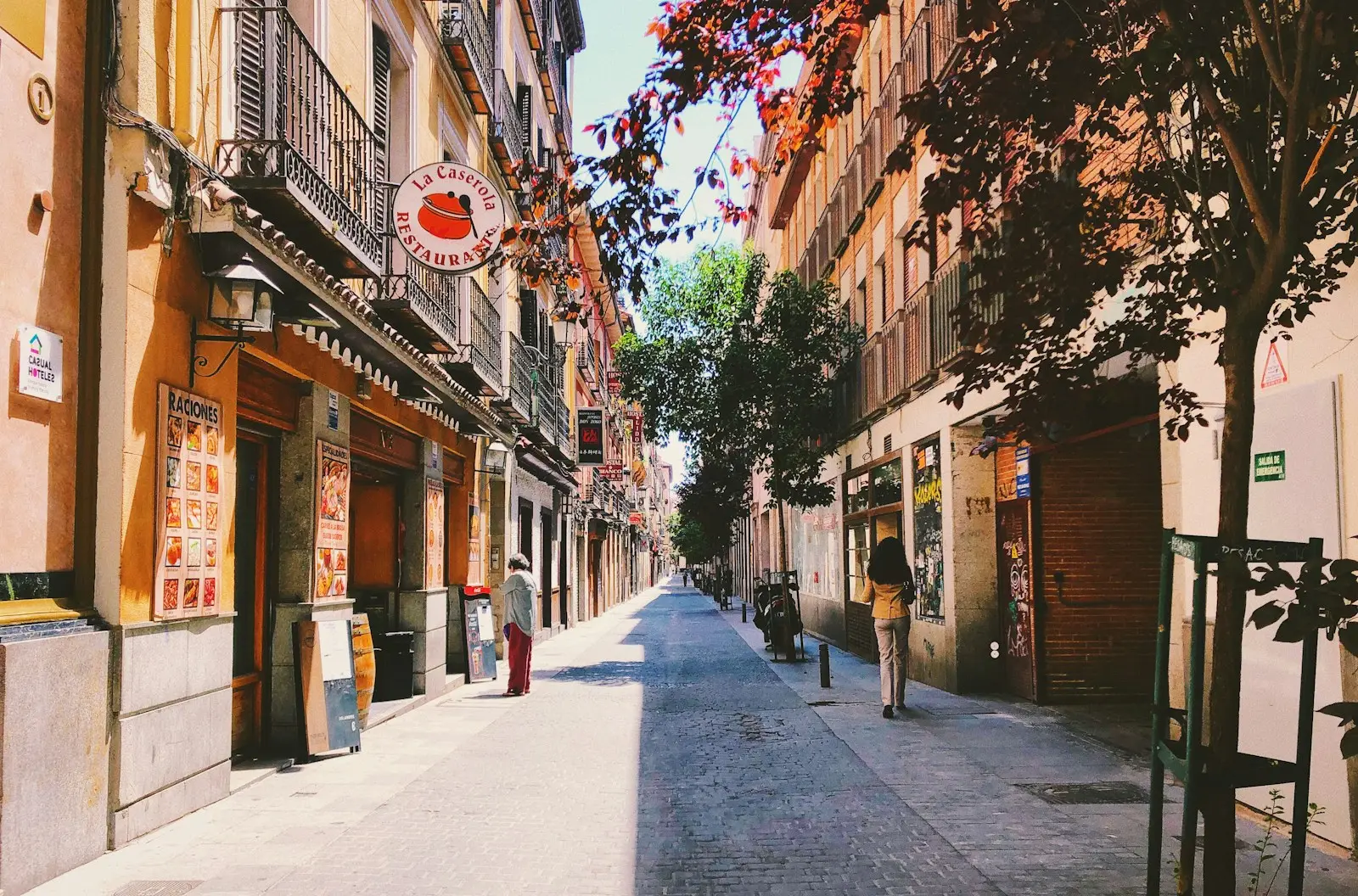
La Cava Baja, in La Latina: the street with more bar counters per meter than anywhere else in Spain — Alex Vasey / Unsplash
4. What to order, and where
Not a ranking — what to order depending on the type of place.
In a Castilian tavern (zinc counter, tiles, clay jars)
Draught vermut. If they pour it from the tap, it's their calling card
Boquerones en vinagre, conservas (mussels, cockles, anchovies)
Callos a la madrileña. The dish of Madrid, and not for everyone: offal in a thick, rich sauce
Cecina, salt cod in olive oil
In a bocadillo bar
Bocadillo de calamares. The most quintessentially Madrileño tapa and the most gloriously absurd: fried squid rings inside a bread roll, nothing else. It works. The undisputed temple is Bar El Brillante, right next to Atocha station — they've been serving it for decades, and for many people it's simply the best in Madrid.
Anywhere
Tortilla de patata. The eternal debate: with onion or without. In Madrid, almost always with
Croquetas. The thermometer of any bar. If the croqueta is good, everything else will be too
Patatas bravas. Note: real bravas sauce is spicy — not ketchup mixed with mayonnaise
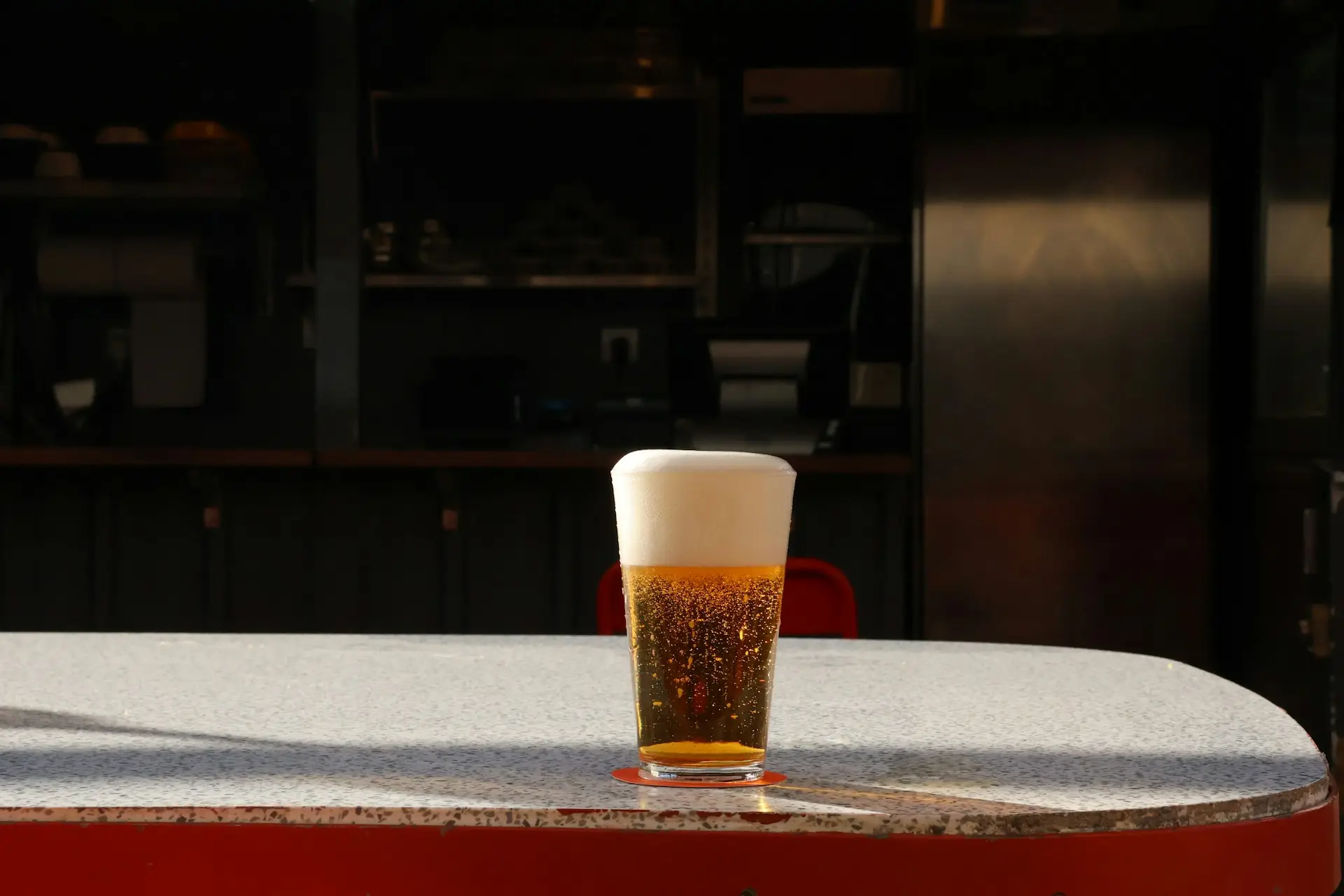
To drink: a caña (small draft beer, always — a pint warms up too fast), vermut at midday, house wine. In a classic tavern, ordering a gin and tonic is a waste of the whole trip.
5. The centenarians: which ones are worth the queue
Madrid has well over a dozen bars that are more than a hundred years old. Not all of them are worth it — but these ones are.
Casa Labra (Tetuán, 12 · near Sol). Open since 1860, and the place where the PSOE was founded in 1879. People come for the battered salt cod and the cod croquetas, ordered at a small counter beside the bar. Practical note: the restaurant dining room is closed — only the tapas bar operates. Open every day of the year except January 1st.
Bodegas Ricla (Cuchilleros, 6). Dating from 1867, right across from Botín. Tiny — no tables, standing only — and family-run. Wine poured straight from the clay jars, draught vermut, anchovies, callos, cabrales with cider. During the Civil War, its cellar served as an air-raid shelter. Closed on Tuesdays.
La Ardosa (Colón, 13 · Malasaña). The tortilla pincho is non-negotiable, and the beer is always well poured. It's always full, and there's always room for one more.
Taberna de Ángel Sierra (plaza de Chueca). Open since 1917, with its original carved wooden bar and pewter fittings still intact.
A word of warning: opening hours at these old-timers can shift, and some close on random days. Check before you go. Bodegas Ricla closes on Tuesdays; many close in August.
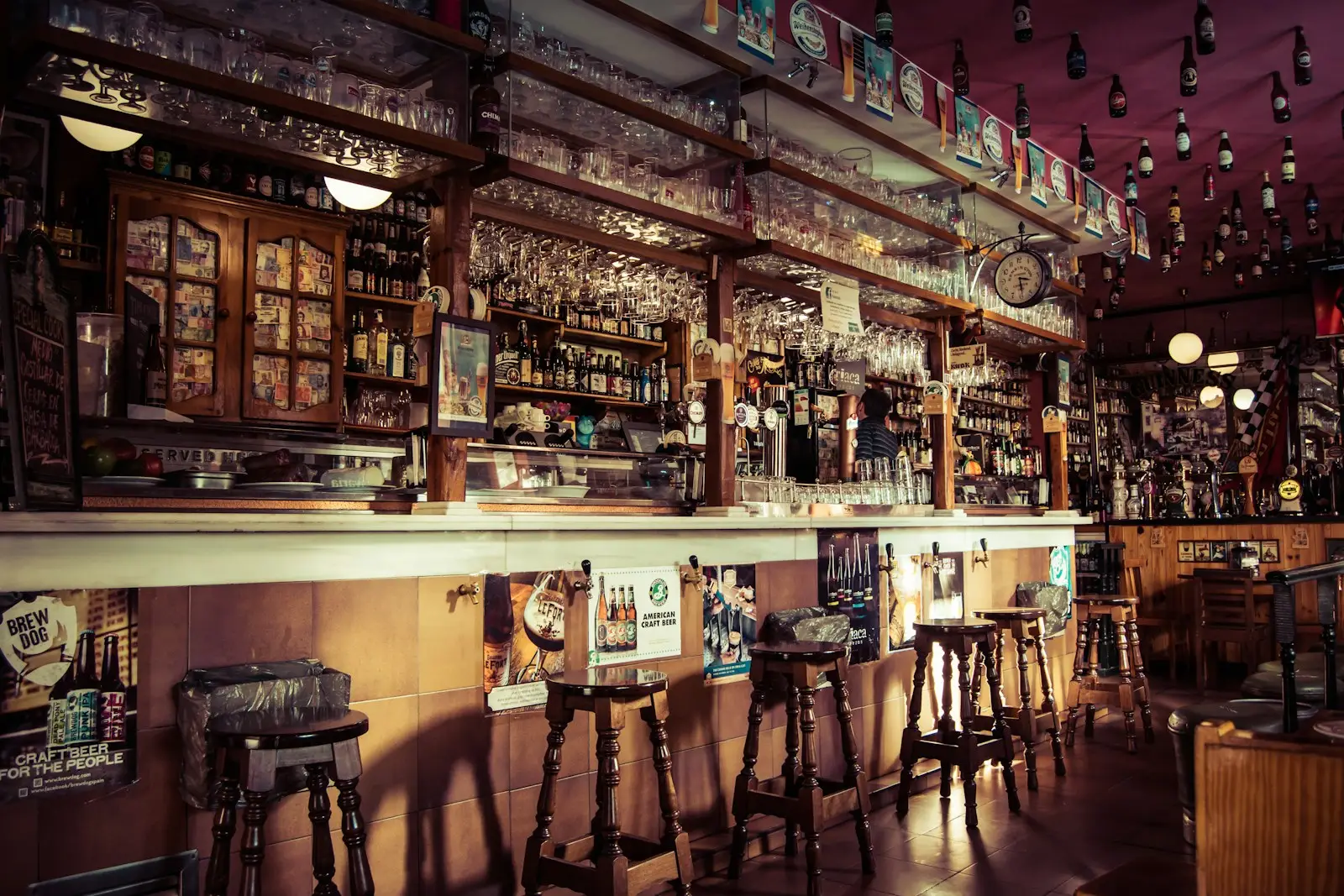
Inside a century-old Madrid bar: stools, bottles, and an atmosphere straight out of another era — Maria Voss / Unsplash
6. What to avoid
This is where most articles about tapas in Madrid let you down.
El Mercado de San Miguel. Stunning to look at, and a total trap. It's a gourmet market built for tourists: tiny portions at restaurant prices, nowhere to sit, and nothing on offer is better than the bar around the corner. It has one legitimate use: sampling a lot of different things in an hour if you're genuinely short on time. For a real tapas experience, skip it.
The terraces around the Plaza Mayor. You're paying for the view. The bravas cost three times as much and they're no better.
Any bar with photos of the food on the door. A universal rule, and in central Madrid it never fails.
Organized tapas tours for 60 euros. Unless you want company, you can do the same route yourself with this article and spend a third of the price.
The Cava Baja bars on a Saturday at nine. It's not that they're bad — it's that you won't get in. Go on a weekday, or show up at seven.
7. How to put together a route that actually works
You don't need a plan — but you do need a few ground rules:
Three or four bars, not ten. One tapa and one drink at each. The beginner's mistake is sitting down at the first place and ordering a full spread — at that point, it's dinner, not tapas.
Standing at the bar. Sitting at a table usually costs more and kills the rhythm.
Start around 19:30–20:00. By 21:00, everything is packed.
Weekdays beat weekends. Same bars, half the crowd.
Follow the locals, not the reviews. A bar full of people speaking Spanish at eight in the evening is a better sign than four and a half stars on Google.
A route that works, building as you go: start at Casa Labra for the salt cod (Sol) → walk down to Bodegas Ricla for the vermut and anchovies (Cuchilleros) → continue to the Cava Baja for two or three more stops → finish wherever the night takes you. It's a fifteen-minute walk from one end to the other.
8. If your visit coincides with these
Tapapiés (Lavapiés, mid-October — in 2026, from the 15th to the 25th). The neighborhood's tapas and music festival: more than twenty bars, tapas at accessible prices, live music in the streets. It's not a standard tapas crawl — it's tapas with concerts and the full energy of a local community celebration.
World Tapas Day (third Thursday in June). Lavapiés marks it with the croqueta in the starring role: more than twenty bars serving their own version at a special price.
9. The practical stuff
How much it costs. A caña with a tapa runs between 3 and 5 euros at a neighborhood bar; in the tourist center, expect to pay double. A four-bar crawl with a tapa and a drink at each works out to around 25–35 euros per person.
How to pay. Almost everywhere accepts cards, but some of the smaller historic bars don't. Carry cash.
How to order. At the bar, out loud, without hesitation. There's no queue or number system — the bartender keeps a mental tally of who arrived first. Waiting politely to be noticed is the surest way to go hungry.
Tipping. Not expected at a bar counter, and nobody will think twice if you don't. Rounding up slightly is perfectly fine.
August. Half the city closes down. That includes the historic bars. Check before you go.
Where to stay in Madrid
For a tapas trip, location matters: if you're staying in the center, La Latina and Lavapiés are both walkable and you won't be dependent on the metro to get home. At Fee4Me we manage vacation rentals in Madrid designed to work from the moment you arrive — fully equipped kitchen, real living space, and direct communication throughout your stay.
No. Unlike in Granada or León, in Madrid you pay for your tapa. There are occasional exceptions in Lavapiés and Malasaña, but it's not the norm. What Madrid does offer is variety: Castilian taverns, Basque pintxos bars, Asturian cider houses, and modern creative spots all coexist in the same city.
The vermut hour runs from 13:00 to 14:00, especially on weekends. The main tapas window opens at 19:30, and by 21:00 everywhere is full. Between 16:00 and 19:30 most kitchens close, so if you're out at an off hour, stick to tapas bars that keep their counter open.
La Latina is the classic choice: the Cava Baja packs more bar counters per meter than any other street in Spain. Lavapiés is more multicultural and slightly cheaper. Malasaña is the modern alternative. If you're staying for more than a weekend, Chamberí and Argüelles are where the city's own people actually eat.
Not for a real tapas experience: small portions at restaurant prices and always heaving. It's only worth it if you have very little time and want to sample a lot of things at once. The neighborhood bars nearby are better and cost half as much.
Between 25 and 35 euros per person for four bars with a tapa and a drink at each, in a residential neighborhood. In the tourist center, prices can easily double. A caña with a tapa is around 3–5 euros outside the busiest areas.
Experiences
Book your activities in Madrid
Curated experiences by GetYourGuide, our official partner.