48 Hours in Barcelona: from the Gothic Quarter to Barceloneta
Two days are enough to traverse twenty centuries: from the medieval labyrinth of the Barri Gòtic to the Mediterranean shores of Barceloneta, with Gaudí's modernisme written in stone along the way. This is the route for making the most of a weekend without rushing.
Some cities are meant to be rushed through; others ask you to slow down. Barcelona, in 48 hours, is an exercise in balance: between the Gothic Quarter and the sea, between centuries-old stone and a mid-afternoon vermut, between the perfect grid of the Eixample and the beautiful disorder of Barceloneta. Two days hold a great deal — but not everything — and that, precisely, is the first lesson: learning to choose.
The city reads like a palimpsest. Beneath the asphalt lies a Roman Barcino; above it, the medieval street plan that still sets the rhythm today; higher still, the Modernista explosion that turned it into an open-air museum; and always, in the background, the Mediterranean that gives it its temperature and character. This route moves through all of them without haste, leaving time to get lost — which in Barcelona is, almost always, the surest way to find it. Five neighborhoods, two days, a handful of corners worth the entire journey.
48 hIdeal duration
5 neighborhoodsNot to be missed
2,000 yearsOf visible history
4.5 kmOf urban beach
Chapter I
The Gothic Quarter, medieval heart
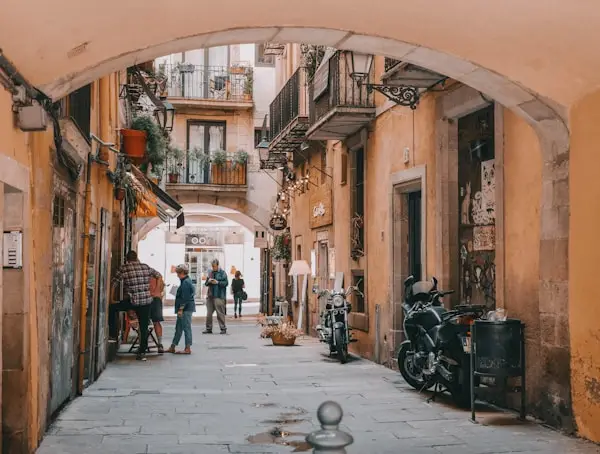
Begin where the city began. The Barri Gòtic is a maze of narrow alleys where light falls hard on golden stone and every corner conceals centuries. The natural starting point is the Catedral de Barcelona, dedicated to Santa Eulàlia: don't linger only at the neo-Gothic façade — step into the cloister, a leafy sanctuary where thirteen white geese live, one for each year of the martyr's life, and climb to the terrace to look out over a sea of rooftops and gargoyles.
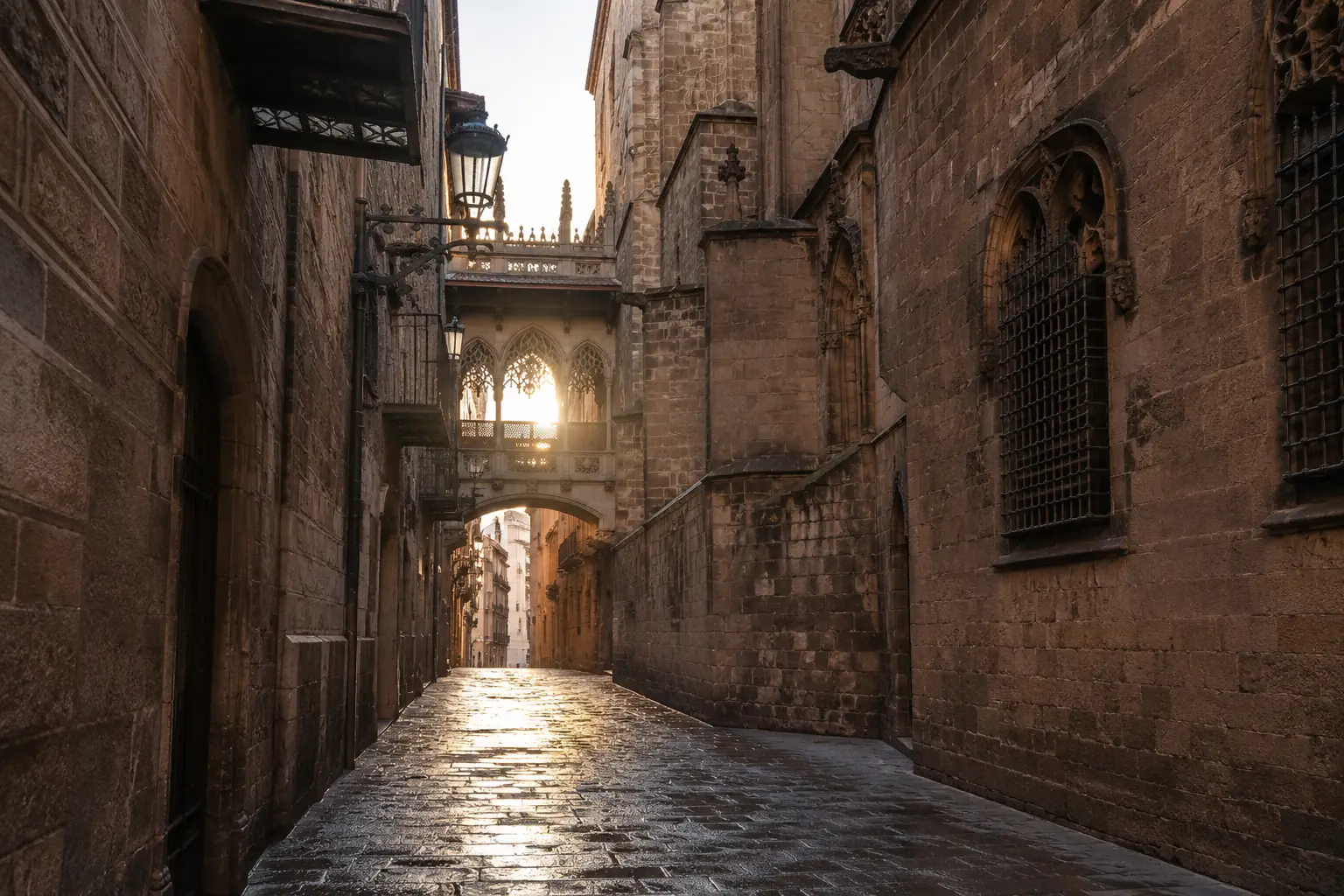
From there, walk toward Plaça Sant Jaume, the city's political heart since Roman times: this was the forum of Barcino, and today the Ajuntament and the Palau de la Generalitat stand face to face across it. A few steps away, turn down Carrer del Bisbe and pass beneath the Pont del Bisbe, that delicate neo-Gothic bridge that looks medieval but dates from 1928 — the most photographed corner in the neighborhood, and justifiably so. Continue then into El Call, the old Jewish quarter, one of the best preserved in Europe, with alleyways so narrow the sun barely squeezes through.
Don't miss two understated stops: Plaça de Sant Felip Neri, a quietly intimate little square with a fountain and Civil War scars still etched into its walls, and the Temple d'August, four Roman columns tucked away in the courtyard of a building on Carrer Paradís that almost nobody finds on the first try. The advice for the Gothic Quarter is simple: leave the map behind and go early. By mid-morning the neighborhood fills up; at dawn it belongs to you, silent and golden, and losing yourself in its streets is all part of the plan.
A laneway in the Barri Gòtic at dawn
"In the Gothic Quarter you don't walk in straight lines: you surrender to alleyways that have spent centuries waiting to be discovered."
Barcelona itinerary · Fee4Me
Chapter II
El Born: bohemian spirit, design, and an interior sea
Cross Via Laietana and you change centuries without changing era. El Born — officially La Ribera — was a neighborhood of guilds and merchants, and it still feels that way: its streets bear the names of old trades (Sombrerers, Mirallers, Argenteria) and today mix design studios, independent boutiques, and cocktail bars you won't find in any hurried guidebook.
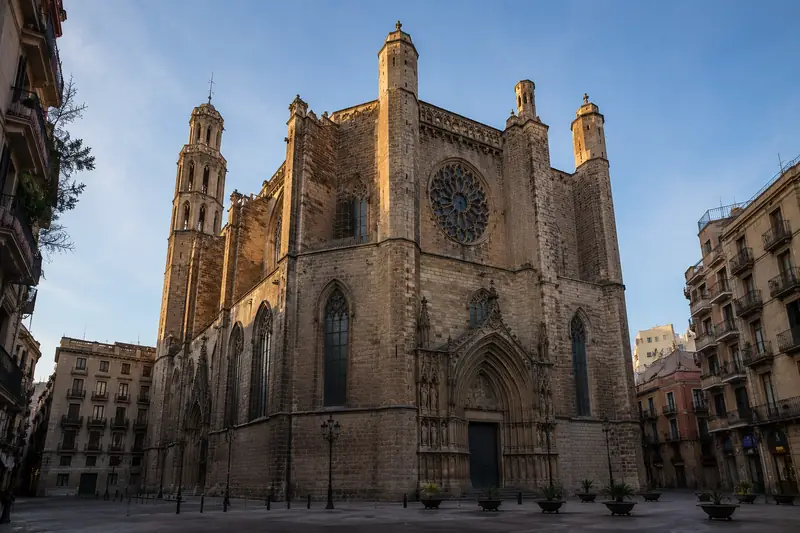
Its crown jewel is Santa Maria del Mar, the "cathedral of the sea" that lends its name to the novel: pure Catalan Gothic, built in just 54 years by the neighborhood's own residents, with a nave so light and luminous it seems to defy gravity. Visit at dusk, when the light pours through the rose window and sit for a moment — this is one of those spaces that demands silence. Just behind it opens the Passeig del Born, the old jousting ground and now the epicenter of the neighborhood's nightlife, anchored by the Mercat del Born, a beautiful 19th-century iron market beneath whose floor lie the ruins of the city razed in 1714.
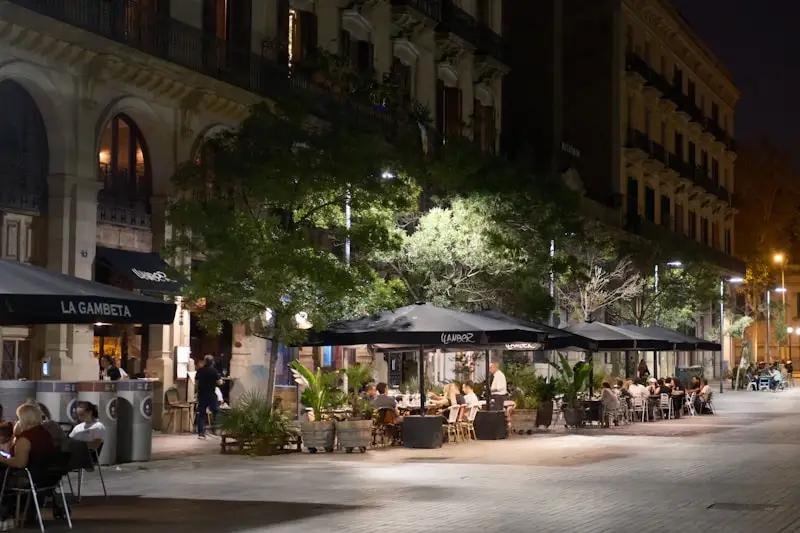
El Born is also Carrer Montcada, a street of medieval palaces sheltering the Museu Picasso, home to the most complete collection of the painter's formative years: book online and save it, if you can, for first thing the following morning. And when evening falls, do what the neighborhood does: step into a historic bodega, order a glass of vermut or a Penedès wine with a plate of Cantabrian anchovies, and let the hours slip by. Here the aperitif is not a formality — it is an institution.
Santa Maria del MarStreets of El Born
Armin Pfarr / Unsplash
Chapter III
Gaudí's Eixample
The second day dawns with Gaudí. Barcelona is laid out on a perfect grid — the Eixample that Ildefons Cerdà conceived in the 19th century, with its chamfered corners that have since become the city's signature — and, amid all that geometry, Modernisme erupts. Start strong: the Sagrada Família right at opening time, when the morning sun streams through the west-facing stained glass and the forest of columns blazes in greens, blues, and ambers. Nearly 140 years after the laying of the first stone it is still growing; to visit it is to witness a living work. Book well in advance and, if you can, pay for access to the towers.
From there, walk down toward Passeig de Gràcia, the city's most elegant boulevard and an open-air catalogue of Modernisme. On a single block — known as the Illa de la Discòrdia — Gaudí's Casa Batlló, with its scaly façade and balconies that resemble carnival masks, stands alongside Puig i Cadafalch's Casa Amatller. A short distance further stands La Pedrera (Casa Milà), that undulating mountain of stone without a single straight line, crowned by chimney stacks that have inspired more than one filmmaker. You don't need to go inside all of them: choose one for an interior visit — Batlló is the more striking — and enjoy the rest from the street, eyes always tilted upward.
If energy and curiosity allow, head up to the Gràcia neighborhood, right alongside the Eixample: it was an independent town until 1897 and still feels like one, with its pedestrian squares — Plaça del Sol, Plaça de la Virreina — packed with terraces where barcelonins live their real daily lives, far from the tourist circuit. It is the perfect spot for a mid-afternoon rest before heading back down to the sea.
The stained-glass windows of the Sagrada Família at dawn
"The Sagrada Família is not visited — it is contemplated as it continues to grow, stone by stone, nearly 140 years on."
Barcelona itinerary · Fee4Me
Chapter IV
Barceloneta and the Mediterranean
Every Barcelona itinerary ends looking out to sea. Barceloneta was born in the 18th century as a fishermen's neighborhood, with its elongated blocks and narrow two-story houses designed to let in the sea breeze, and it still smells of salt, fishing nets, and rice. Wander first through its interior — the streets of Barceloneta are a village within the city, with laundry strung between balconies and bars where people eat standing up — before stepping out onto the Passeig Marítim.
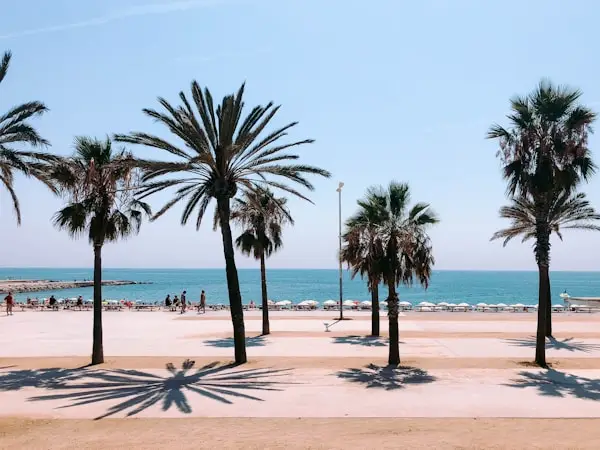
Once by the water, walk the breakwater all the way to the tip, where the city falls away and there is nothing but water and horizon. Then return to the beach: 4.5 kilometers of urban sand that begin here and stretch toward the Fòrum, with the golden silhouette of the Vela hotel and Rebecca Horn's stack-of-cubes sculpture, "L'Estel Ferit", as a backdrop. This is the place to do nothing for an hour: sit, watch the sea, and let two days of stone quietly settle.
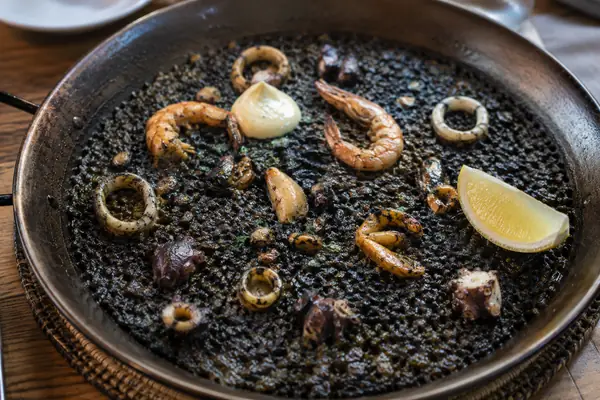
And then, eat facing the water. Barceloneta is a temple to arròs and the finest seafood: a paella or, even better, an arròs a banda or an arròs negre; a plate of "bombas" — the potato croquettes stuffed with meat, invented right here, served with brava sauce and alioli; some "xipirons" cooked à la Andaluza. Steer clear of the tourist traps on the front row with menus in ten languages, and seek out the old-faithful spots, tucked slightly out of sight. After two days of walking on stone, the sea tastes different — and so does the rice.
Eating is half of Barcelona, and no 48-hour itinerary is complete without surrendering to its markets and its gastronomic rhythm. The most famous is the Mercat de la Boqueria, right on the Rambla: spectacular, yes, though increasingly geared toward visitors; go at first light, when it is still a real working market, and have breakfast at one of its historic counters. But the real secret lies a little further on: the Mercat de Santa Caterina, with its rippling ceramic-mosaic roof designed by Enric Miralles, is more local, more peaceful, and every bit as rewarding.
The Barcelona day has its rituals. The esmorzar de forquilla — the hearty "fork breakfast" taken mid-morning at a neighborhood bar — is a tradition worth experiencing at least once. At midday, vermut: any bar worth its salt pours it from the tap with a splash of soda, an olive, and a patata brava, and the clock simply stops. For lunch, escape the Ramblas and look for neighborhood tapas in the Gòtic, El Born, or Gràcia: pa amb tomàquet, croquetes, calamars, escalivada. And at any hour, finish with a crema catalana or a glass of cava from the Penedès.
One practical tip worth ten others: book the big-ticket visits (Sagrada Família, Casa Batlló, Museu Picasso) several days in advance, avoid the most touristed spots at midday, and get around on foot or by metro — Barcelona is a city made for walking, and the best things happen between one stop and the next. The city is remembered as much for what you taste as for what you see.
On the map
1
Barri GòticCathedral, Plaça Sant Jaume, and medieval street plan
2
Santa Maria del MarCatalan Gothic in El Born
3
Passeig del BornBars, design, and the Mercat del Born
4
Sagrada FamíliaGaudí's living masterpiece
5
Passeig de GràciaCasa Batlló and La Pedrera
6
La BarcelonetaBeach, breakwater, and rice dishes
7
Mercat de la BoqueriaFlavor at the heart of the Rambla
Barcelona doesn't end in 48 hours — but you begin to fall for it on the first stroll through the Gothic Quarter, and you never quite forget it after the last bowl of rice facing the sea.
Experiences
Book your activities in Barcelona
Curated experiences by GetYourGuide, our official partner.